
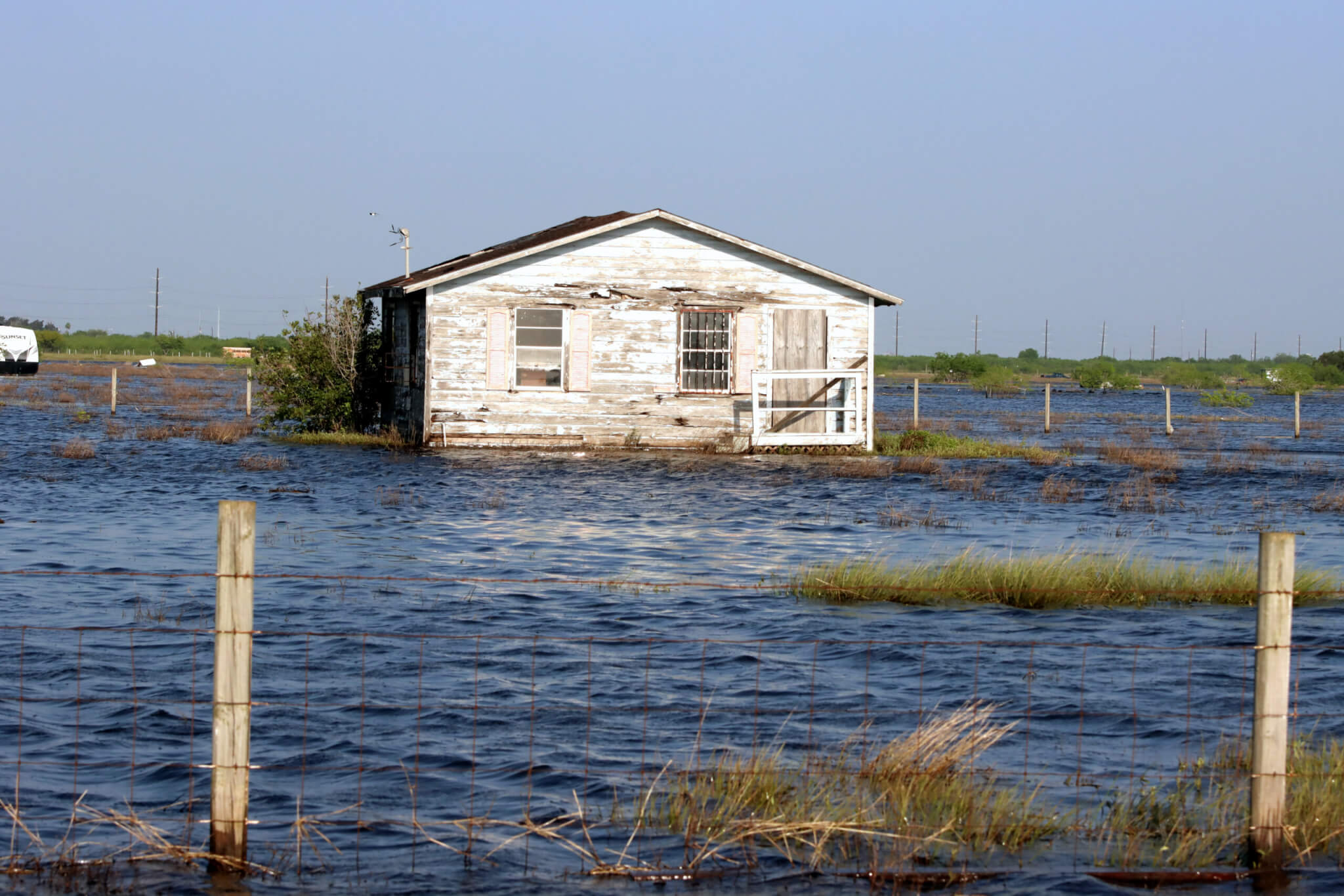
Floodwaters surround a Green Valley Farms home in late March. (San Benito News/Ray Quiroga)
NEWS Staff Report
The Federal Emergency Management Agency [FEMA] has established a site in San Benito as the federal agency accepts applications for claims on damages that occurred during the flooding that took place in the Valley in late March of this year.
FEMA representatives are on hand at the San Benito Parks and Recreation Building, located at 705 N. Bowie St., San Benito, from 8 a.m. to 7 p.m., daily.
In coordination with the Texas Division of Emergency Management [TDEM], FEMA and U.S. Small Business Administration [SBA], Disaster Recovery Centers [DRCs] opened locally on May 28, offering in-person help to residents of the four South Texas counties affected by the severe storms and flooding that occurred March 26-28.
Homeowners and renters in Cameron, Hidalgo, Starr, and Willacy counties may be eligible for FEMA assistance for losses not covered by insurance, according to a FEMA press release.
FEMA and SBA are supporting state-led recovery efforts at the recovery centers. Staff can assist survivors in applying for federal assistance. They can also identify potential needs and connect survivors with local, state, and federal agencies, as well as nonprofits and community groups, according to FEMA officials.
Other DRC locations include: Hidalgo County –Weslaco EDC, 275 S. Kansas Ave., Weslaco, TX 78596; Starr County — Starr County Courthouse Annex, 100 N FM 3167, Rio Grande City, TX 78582; Willacy County — Sebastian Community Center, 434 West 8th Street, Sebastian, TX 78594; Cameron County — Harlingen Convention Center, 701 Harlingen Heights, Harlingen, TX 78552.
Residents can visit any open center to meet with representatives of FEMA, the state of Texas, and the SBA. No appointment is needed.
All centers are accessible to people with disabilities or those with access and functional needs, and are equipped with assistive technology. Those needing reasonable accommodations or a sign language interpreter are asked to call (833) 285-7448 [press 2 for Spanish].
FEMA staff are easily recognizable by their official photo identification (ID). Individuals who encounter people offering assistance should first ask to see their identification before sharing personal information.
They may have FEMA clothing, but that can be easily imitated, warn FEMA officials.
FEMA staff can help residents in several ways, including:
• Checking the status of an application already in the system and making minor changes to applications.
• Contacting faith-based organizations, community groups, private sector businesses, and public libraries that may have the capability to distribute disaster-related information to residents in the impacted counties.
• Identifying organizations providing disaster-related services and/or resources to the public for long-term recovery.
• Gathering information about impacts to communities.
• Providing flyers explaining how to apply for disaster assistance.
Survivors with homeowners’ or renters’ insurance should first file a claim with their insurance company as soon as possible. If your policy does not cover all your damage expenses, you may then be eligible for federal assistance.
SBA’s Customer Service Representatives are available at the centers to answer questions, assist business owners in completing their disaster loan application, accept documents, and provide updates on an application’s status.
For information and to apply online, visit SBA.gov/disaster. Applicants may also call the SBA’s Customer Service Center at (800) 659-2955 or email disastercustomerservice@sba.gov for more information on SBA disaster assistance. For people who are deaf, hard of hearing, or have a speech disability, dial 7-1-1 to access telecommunications relay services.
Survivors can apply to FEMA in several ways, including visiting DisasterAssistance.gov online, downloading the FEMA App for mobile devices, or calling the FEMA Helpline at 800-621-3362. Calls are accepted every day from 6 a.m. to 10 p.m. Help is available in most languages.
Those using a relay service, such as video relay (VRS), captioned telephone, or other service, should give FEMA the number for that service. To view an accessible video on how to apply visit: Three Ways to Register for FEMA Disaster Assistance – YouTube.
For more information, visit fema.gov/disaster/4871. Follow FEMA Region 6 on social media at x.com/FEMARegion6 and at facebook.com/FEMARegion6/.
FEMA’s mission is to help people before, during, and after disasters.
Disaster recovery assistance is available without regard to race, color, religion, nationality, sex, age, disability, English proficiency, or economic status. If you or someone you know has been discriminated against, call FEMA toll-free at (833) 285-7448. If you use a relay service, such as video relay service (VRS), captioned telephone service, or another type, provide FEMA with the number for that service. Multilingual operators are available (press 2 for Spanish). Learn more at fema.gov/disaster/4871 May 2025.
When March’s rain event was over, some 13 hours after it commenced, an estimated 18-21” of rain is believed to have fallen on the area. Sections of downtown Harlingen had endured up to waste-high flooding in what’s being called “The Flood of the Century,” breaking known rainfall records in the Rio Grande Valley dating back that long or longer.
The Arroyo Colorado crested at 30.44’, shattering the previous record set on July 21, 2010, of 24.22’. Thus far, six RGV deaths that night are believed to have been weather-related, according to the National Weather Service Brownsville/RGV station [NWSB].
At least 1,000 buildings were flooded Valley-wide, reads the NWSB report on the storm. Another 1,000 vehicles sustained severe water damage and were abandoned, while “an unknown number of roads and bridges sustained structural damage due to the floodwaters,” according to the NWSB.
Valley International Airport in Harlingen canceled all flights through March 31 due to flooded taxiways and other damage to its pavement.
By the weekend, state and local officials, including various mayors and county judges in the Rio Grande Valley, signed disaster declarations with Texas Governor Greg Abbott. Following this, the state issued a disaster declaration for Cameron, Hidalgo, Starr, and Willacy counties on March 29.


Recent Comments