
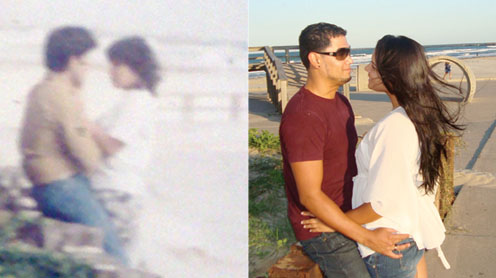
Left: Graciela de Jesus Cruz and Cezar Rodriguez are shown at Isla Blanca Park in 1989. (Courtesy Photo) Right: Sarahi and Sergio Lopez stand where her parents are shown (left) on the Island over 20 years ago. (Photo by Lauren N. Laughlin)
By LAUREN LAUGHLIN
Special to the NEWS
Each year, Americans observe National Hispanic Heritage Month from Sept. 15 to Oct. 15 by celebrating the history, culture and contributions of American citizens whose ancestors came from Spain, Mexico, the Caribbean and Central and South America.
The observation started in 1968 as Hispanic Heritage Week under President Lyndon Johnson and was expanded by President Ronald Reagan in 1988 to cover a 30-day period. It was enacted into law on Aug. 17, 1988, on the approval of Public Law 100-402.
The day of Sept. 15 is significant because it is the anniversary of independence for Latin American countries Costa Rica, El Salvador, Guatemala, Honduras and Nicaragua. In addition, Mexico and Chile celebrate their Independence Days on Sept. 16 and September18, respectively. Also, Columbus Day or Día de la Raza, which is Oct. 12, falls within this 30 day period.
A recent report by the City Data website on a poll taken in 2011 states that Cameron County is 75 percent Hispanic and 24 percent of the population are foreign born.
Many persons who cross into the United States stay close to the border and most share a similar story. Sarahi Lopez was kind enough to share hers. It’s the tale of a family and the courage they faced living in an unknown land looking for something better.
Sarahi’s mother’s maiden name is Graciela de Jesus Cruz, she was born in Nicaragua on Dec. 22, 1968 and lived most of her childhood on her parents ranch. When Nicaragua’s government collapsed around 1979, two main groups emerged, the Sandinistas and the Contras. The Sandinistas wanted to govern Nicaragua with a Marxist-Leninist type government, but the Contras, which means “against,” did not agree and violence between the two groups erupted. Many farmers lost their livestock and land due to violent gangs supporting the Sandinistas, which caused de Jesus Cruz and all of her the family to seek refuge in the country of Honduras. Many of the followers of the Contras sought refuge in Honduras, and with not enough men to help with the cause, they would draft young children from the age of 12 into battle.
De Jesus Cruz joined the Contras at the age of 15 and learned basic nursing, but soon she was not only fighting to recover all that her family lost but also fighting to stay alive. Already in danger fighting against Sandinista groups, de Jesus Cruz faced the constant threat of being raped, along with the other women who worked with her, by the men she fought alongside. As the violence became worse, de Jesus Cruz made the decision to leave the military and Honduras to seek refuge in the United States.
At 18 years old and with only $100 in her pocket, she left with a friend, who also had to deal with the same threats, and traveled through Honduras, El Salvador, Guatemala and Mexico to arrive at the U.S border. She made it to Matamoros and was able to cross the Rio Grande without being apprehended by the U.S. Border Patrol.
After making it safely inside the United States, de Jesus Cruz lived in Los Fresnos, TX, where she met and fell in love with Cezar Rodriguez, who was also Nicaraguan seeking refuge in the United States. Not knowing how to speak English, de Jesus Cruz found it hard to find work because she was an illegal immigrant. De Jesus Cruz eventually found a job working in homes where she cleaned and sometimes worked farms picking produce along with Rodriguez.
Sarahi said, “My parents did not understand that, at that time, they qualified to receive political asylum from the United States, which would allow them to become U.S. residents. Both of them accepted the fact that life was going to be hard living in fear and always hiding from law enforcement, but they would do anything to survive and never go back to Nicaragua, even claiming to be Mexican just in case they were caught so that they would not get deported all the way back to Nicaragua.”
Soon after coming to the United States, de Jesus Cruz and Rodriguez moved to Florida and were expecting their first child, Sarahi. But before she was born, Rodriguez died in a car accident. De Jesus Cruz was left alone and received helped from a couple of friends – who at the time were the only people she knew. One of her friends told her of Chicago and the opportunities there would be great for her and Sarahi. Eventually, she was convinced and moved to Chicago in 1990 with a friend, and after Sarahi was born, she decided to move back because she had ended up living in a very bad neighborhood in Chicago, where she would hear gunshots all night and she feared for her life and Sarahi’s life.
Two year later, Sarahi’s sister Sophia was born. Sophia’s father was of Mexican descent but a U.S. citizen. He took care of de Jesus Cruz, but one day he told her that he wanted to visit relatives he had in Mexico. He left but never came back. De Jesus Cruz had no way to reach him and did not know if he had encountered any type of trouble on the way, because she knew that Mexico could also be a dangerous place.
De Jesus Cruz soon learned that she could apply for political asylum and decided that she needed to become a resident and start a better life in the U.S. To do this, she needed to save money to hire a lawyer, but taking care of two young children would make it hard. She then faced making the tough decision of sending the girls, Sarahi and Sophia, to Nicaragua after learning that her parents had restored everything they had lost and the violence there had ended.
Sarahi, then 4 years old, and Sophia, who was a 2-year-old at the time, lived in Nicaragua for four years until de Jesus Cruz was granted a work permit and could reside peacefully in the U.S. The girls moved to Tampa Florida to be with their mother and go to school in the United States.
“We spoke some English as small children but then moved back to Nicaragua where we spoke only Spanish and lost all English,” Sarahi recalled. “When we moved back to the states, we had to learn again. It was hard because my mother still did not know English.”
Sarahi added, “We went to school and taught my mother how to speak English. I remember one time, when she got her first cell phone; you could change the settings to Spanish. But we didn’t because it would help her learn.”
After 10 years of living in the states, de Jesus Cruz was finally granted permanent residency; however, she could never go back to Nicaragua because she was granted political asylum.
Sarahi said, “My sister and I would go to Nicaragua every summer but my mom could not.”
After 20 years of escaping the violence and moving to the United States, de Jesus Cruz was given clearance and was able to go back to Nicaragua to see her family again.
“My mother always told my sister and I that she wanted us to grow and become professional women, no one in my mother or father’s family has ever been educated at a college level, and she wanted both of her daughters to receive a higher education,” Sarahi said. “As my sister and I became older, my mother became very strict, especially during our high school years because she wanted to make sure we graduated.”
Sarahi joined the Coast Guard in 2009 and is currently working on her degree in criminal justice. Sophia resides in Jacksonville, FL and is also working hard to receive her college degree; she’s married to a man serving in the U.S. Army.
After reporting to her first duty station in South Padre Island, Sarahi met her future husband, Sergio Ivan Lopez who is native of Mexico and shares a similar story.
“We both lived in another country because our mothers wanted to make sure we lived a better life,” Lopez said.
Sergio’s family moved to the United States so his father could receive better medical care. Unfortunately, his father died when he was 5 years old, leaving his mother and brothers in the states where they stayed. Sergio graduated from Port Isabel High School and helped the Tarpon basketball team win the District 32-3A title.
Sarahi said, “We both have learned from the experiences we received watching our mothers struggle and obstacles that we have faced, that there is nothing more important to us than family.”
When asked about her Nicaraguan heritage, Sarahi replied, “It makes me proud and unique. It reminds me of where I come from and how much my family has worked to get me here. Nicaragua is a third world country and they work hard to survive.”
Sarahi and Sergio said that though they’re American, they hold to several traditions from their homelands, such as traditional cooking, dancing and music.
The Lopezes are currently working toward getting Sergio his citizenship and raising a family in the United States and will, of course, visit family in Nicaragua.
To see this story in print, pick up a copy of the Oct. 12 edition of the San Benito News. Or view our E-Edition by clicking here.





Recent Comments