

Abel Fonseca is a San Benito native, boxer, boxing coach, and a longtime Site Coordinator for the San Benito CISD ACE Program at Miller Jordan Middle School and Collegiate Academy. He can be reached at afonseca@sbcisd.net.
Every town has its golden age, but few match the romantic, community-driven spirit of mid-20th-century San Benito.
Long before paved highways sliced through the Rio Grande Valley, life here revolved entirely around the gentle currents of the Resaca de los Fresnos and the vibrant sounds of jazz and conjunto that echoed through the night.
As a kid, some of my favorite moments were spent sitting on my grandmother’s bed, listening to her tell the stories about our community.
She didn’t just share these tales with me; my friends would crowd in to listen, too. As a young child, I gave her the nickname “Maca,” but it didn’t stay a family secret for long. Soon, the kids all around the neighborhood, and even their parents, were affectionately calling her “Maca.”
To the rest of the world, she was the late Evangelina “Evita” (Cantu) Fonseca, born on April 7, 1913.
Historical records confirm that Maca was a legendary pioneer businesswoman in San Benito. While her husband, Pedro “Pete” G. Fonseca, owned and operated the beloved, The Owl Drug Store, Evita ran her own local grocery stores, including La Campana and The Pleasing Food Store.
Her family’s roots run deep in local business, and her brother, Abel Cantu, was also deeply involved in the tight-knit San Benito retail scene.
Maca and Pete raised their only son, Abel Pedro Fonseca, whom everyone in town knew as “Sonny” or “Sonny Boy.”
These grandparents were famous throughout town for serving the best ice cream cones and banana splits, known for their friendliness, honoring a rich legacy passed down from Evita’s own parents.
Generation Two: The Kitchen Innovation That Born “El Taco Rico”
That entrepreneurial Fonseca blood didn’t stop at the grocery and drugstore counters. My dad, Sonny Fonseca, and my mom, Darlene Treviño Owens, went on to carve out their own permanent place in San Benito’s culinary history.
The story of their restaurant is one of pure Valley resourcefulness. While my dad was working hard shifts at Church’s Chicken, he would bring home leftover chicken at the end of the night.
In the family kitchen, my mother, Darlene, began using those leftovers to experiment with different spices, blends, and recipes.
Through trial and error, she engineered a unique, incredibly delicious taco recipe right at home.
Recognizing they had lightning in a bottle, she came up with the perfect name for her creation: El Taco Rico.
The recipe became the foundation for their homegrown restaurant, El Taco Rico, feeding local families for years with the same signature friendliness the family had been known for since the 1930s.
My mom’s sister and mom also worked at the restaurant. To this day, when family comes into town, my mother still whips up a batch of those original, legendary tacos.
Generation Three: From West Texas to the Valle Vista Mall
Years later, that same spirit of enterprise struck our family once again—this time, transforming the sports landscape of the Rio Grande Valley right inside the Valle Vista Mall.
The concept for what became The Soccer House was sparked over 500 miles away. While visiting my wife’s family in the Midland-Odessa area, we went out to support a family member at a local indoor soccer match.
Watching the ball constantly fly out of play in a cramped area got the wheels in my head turning.
I originally planned to launch the venture alongside a close friend, but when my father, Sonny, heard the blueprint, his family business instincts kicked in.
He told me it was an incredible idea and wanted to back the project. Together, we brought the vision to life.
I completely changed the concept, installing heavy, professional-grade plex glass walls around the perimeter—just like a hockey rink—so parents and fans had a crystal-clear view of the turf. To ensure the ball stayed in continuous play, we suspended a massive net completely over the top of the small arena.
But we didn’t stop at the turf. Leveraging the mall’s massive footprint, we built a powerhouse combat sports training ground directly at the back of the facility: Spartans Boxing Academy.
Adorned with our official logo and rallying cry—“Seek the Pain”—the academy became a sanctuary where the daily grind of sparring, pad work, and athletic discipline took place.
The gym served as a vital bridge in my 21-year coaching career, helping forge the elite professional boxers and MMA fighters that represent the RGV on the national stage today.
Porch-Side Memories of a World War II Tanker
But the sweet treats, the savory tacos, and the sports arenas were all built on a foundation of profound sacrifice.
While Maca kept the hometown businesses buzzing, Pete was part of the Greatest Generation, answering a global call to combat.
Years later, the reality of that sacrifice was shared not in a history book, but on a South Texas front porch.
I vividly remember sitting out front with my grandfather, the two of us side by side in rocking chairs.
There, in the quiet night, he shared gripping stories about his time serving as a tanker in the U.S. Army during World War II.
He recounted the terrifying moment an enemy grenade detonated near him—a blast so close and powerful that it permanently cost him a portion of his eyesight.
He brought home different battlefield artifacts from the war, physical remnants of a conflict fought a world away.
Yet, like so many armored veterans of his era, he returned home to San Benito with an unbroken spirit, dedicating his life to his family, city leadership, and his business.
The Golden Era of Rooftop Dancing
The stories Maca painted for us on those afternoons brought a vanished world to life. For the youth of the 1930s and ’40s, weekends meant dressing up and heading to the banks of the water. The crown jewel of local nightlife was the historic Azteca building.
Designed in the shape of a boat, its massive flat rooftop served as the city’s premier open-air public dance hall.
Couples spun under the stars while orchestras played from a large, acoustic, shell-shaped bandstand.
The music carried across the midnight waters, prompting neighbors blocks away to sit on their porches just to catch the fading notes. Downstairs, the community gathered for waterfront dining, enjoying the cool breeze coming off the waves.
Floating on the Resaca Queen
By day, the resaca was where everyone went to row boats and socialize. Families regularly took small rowboats and canoes out onto the 80-foot-wide waterway to escape the South Texas heat.
But the undisputed highlight for local children was the Resaca Queen.
Sponsored and operated by the San Benito Lions Club, this large, flat-bottomed pontoon boat provided free rides to the public on weekend afternoons.
Generations of families recall piling onto the boat, waving to neighbors gathering along the banks, and drifting past the boat-shaped Azteca building.
It wasn’t just a boat ride; it was a weekly community ritual that cost nothing but brought neighbors together.
Keeping the Echoes Alive
Evita “Maca” Fonseca lived to be 94 years old, carrying with her a century of stories passed down from her parents and lived through her own independent eyes.
Today, the old drug store counters have changed hands, the neighborhood kitchens have grown quiet, and the free pontoon boat rides on the resaca have long since become a thing of the past.
Yet, the spirit of that era remains. Through modern community gatherings like Resacafest and the careful preservation of the Texas Conjunto Music Hall of Fame now occupying the Azteca building on Robertson St., our town continues to honor its roots.
By sharing these memories, we ensure that the rhythms, the bravery, the flavors, the sports innovations, and the community pride of the Cantu, Treviño, and Fonseca generations are never truly lost to time.
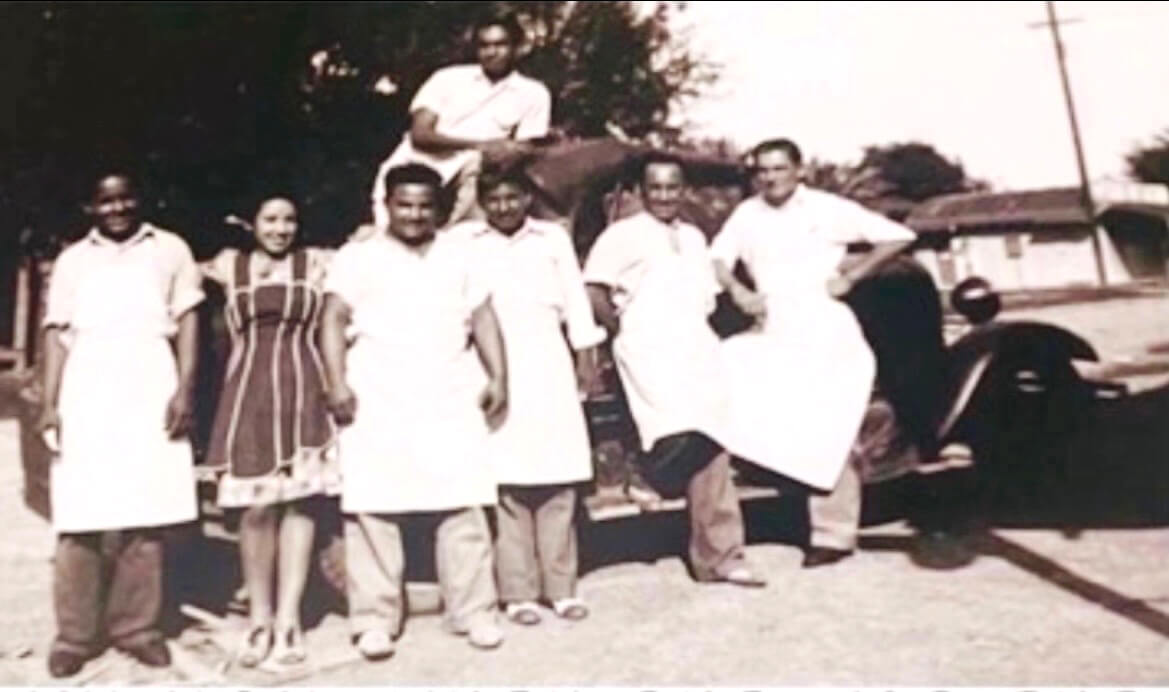
(Archival photo/Abel Fonseca)





Recent Comments