
By TRINA “INDI” JOHNSON
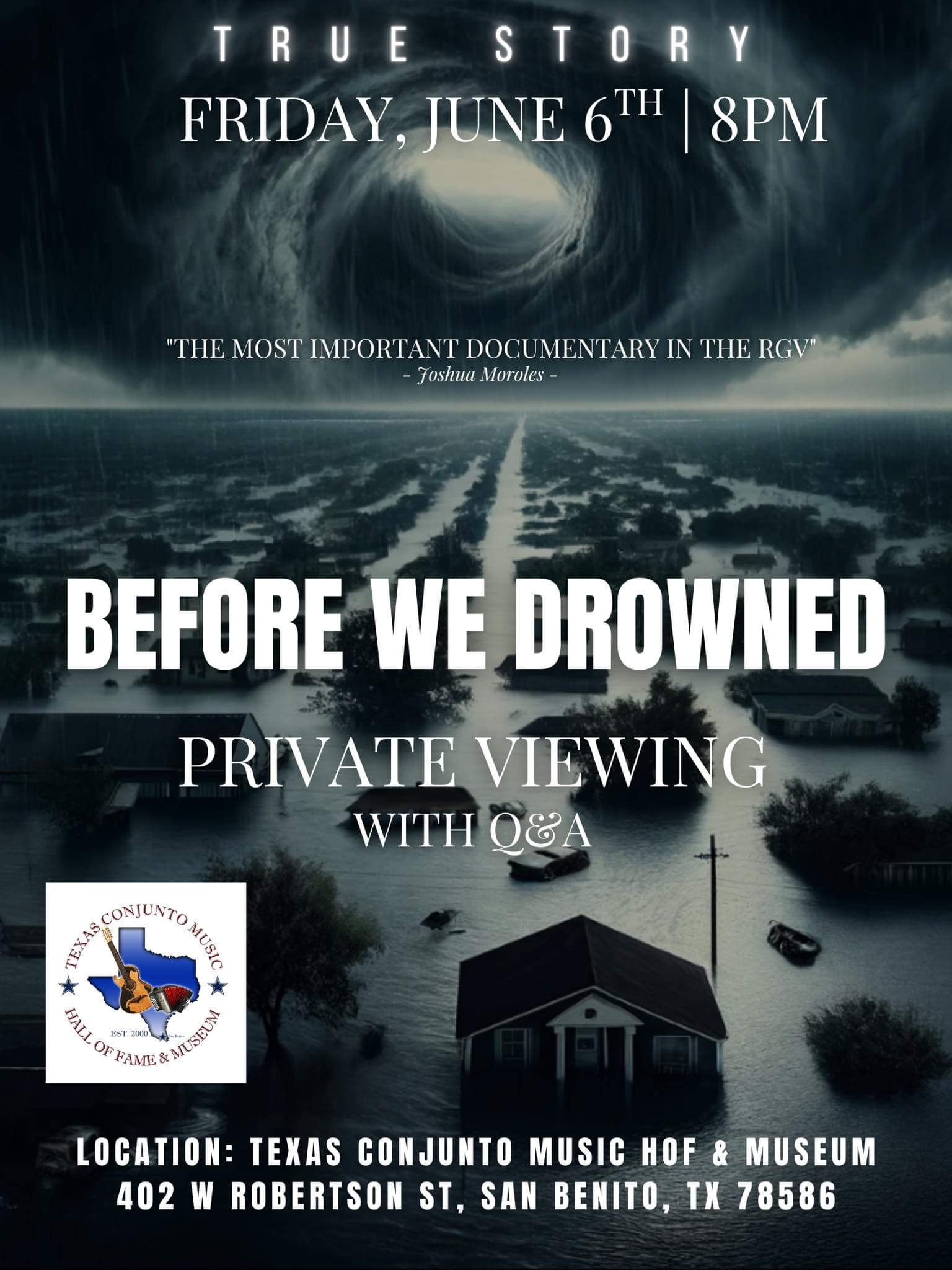
A stark warning about a public health crisis quietly brewing in the Rio Grande Valley will be unveiled on June 6, 2025, when filmmaker Joshua Moroles hosts an exclusive private screening of his latest documentary, Before We Drowned, at the Texas Conjunto Music Hall of Fame & Museum in San Benito. The event, set to begin at 8 p.m., is expected to draw a crowd eager to confront the region’s environmental threats, with a Q&A session promised to unpack the unsettling truths uncovered in the film.
The documentary, described by Moroles as “the most important in the RGV,” explores the catastrophic consequences of flooding in the region, particularly the overflow of the Arroyo Colorado, where banned chemicals and toxins mingle with sewage, seeping into homes and exposing residents to dangerous diseases.
The film was completed in a remarkably swift 25 days, with research beginning on March 27, the very day floods swept through the Valley. “I dove into the facts and data as the storm unfolded,” Moroles wrote. Yet, the process was far from easy. “The most difficult part was the overwhelming amount of information I uncovered,” he admitted. “As I dug deeper, I kept discovering more pollution and environmental threats affecting the region. But you have to draw the line somewhere.”
Moroles, a documentarian driven not by profit but by passion, has never earned a dime from his work. His previous films, The Collapse and Conquista, garnered 16 and six Best Documentary Feature awards, respectively, yet his focus remains on the Valley’s future. “I do this because I care deeply about our home, our families, our friends, our neighbors,” he wrote. “If you’ve ever wondered why there are so many sick people here in the RGV, this will give you a clue.”
The choice of San Benito for the premiere was deliberate. “This area was hit the hardest by the storm,” Moroles explained. “It only made sense to premiere the film in the community most directly impacted, to honor their experience and give them the first voice in this conversation.” The Texas Conjunto Music Hall of Fame & Museum is expected to be filled with concerned citizens, with Moroles hoping for a turnout so robust that “people are standing after every seat is taken.”
The documentary’s message is urgently underscored by projections that the RGV’s population will double by 2040 to 2045. “If we don’t act now, we are going to leave behind a disaster for our children’s children,” Moroles warned gravely. “We’ve been dealing with this since the 1990s, and 35 years later, we’re still dealing with it.”
A Q&A session following the screening will allow Moroles to share additional findings not included in the final cut, ensuring the community is thoroughly informed. “There’s a lot of important information that didn’t make it into the film,” he noted, eager to engage directly with attendees.
Though largely a solo endeavor, Moroles credited social media for amplifying his message, though his petition for action has yet to reach its goal of 10,000 signatures. “We’re seen as a group of concerned citizens,” he wrote. “Once we hit that number, the momentum will shift, and that’s when real change can begin.”
Success, for Moroles, hinges on the audience’s takeaway. “If they walk away realizing they can’t take their health and environment for granted, that’s what matters,” he shared. “This is our home, and being informed is the first step toward protecting it.”
The film, currently submitted to festivals, won’t be publicly released until January 2026, but Moroles plans additional private screenings across the RGV. For now, the June 6 event stands as a clarion call to a community teetering on the edge of a crisis too long ignored.
Tickets for the screening are available through Moroles’ outreach channels. The event begins at 8 p.m., with attendees encouraged to arrive prepared to ask questions and participate in a discussion after viewing the film.


3 comments
Will you be having this event in the mid valley— Edinburg/Mcallen area?
Otherblanca@yahoo.com
Sign the petition. There are 82,000 homes and 300 facilities that are directly in the RGV Flood plain, that’s how many signatures should be on this.