
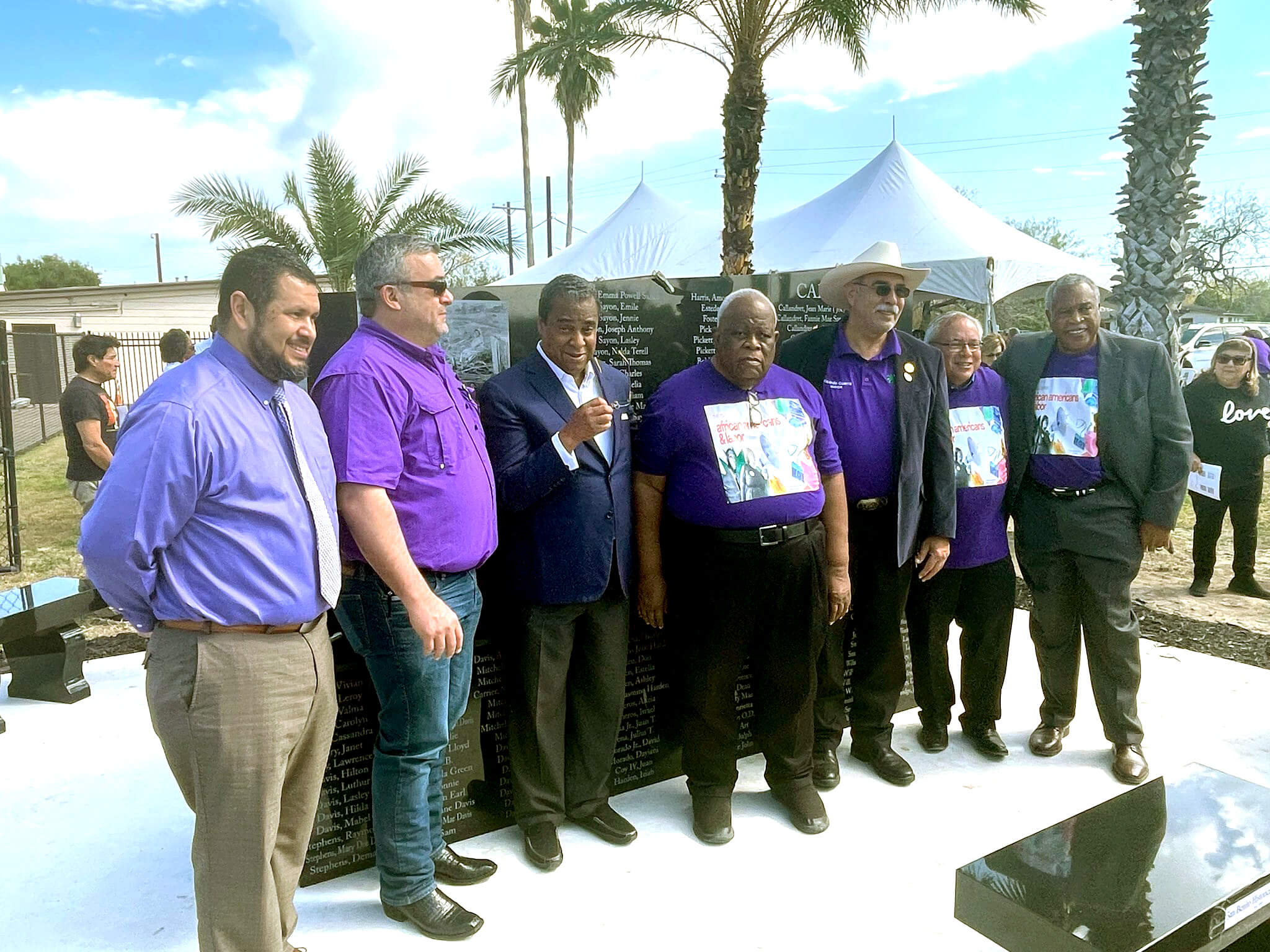
(Courtesy photo/SBHS)
By ALBERT VILLEGAS
Special to the NEWS
For some present-day local leaders, seizing history to cultivate future minds was the reason the unveiling of the Black Pioneers of San Benito Monument was held last week, Feb. 1.
It attracted an estimated 60 people on a sunny Saturday afternoon to the grounds of the Callandret Black History Museum in San Benito, 305 Doherty Street.
The building is located in the “El Jardin” neighborhood of the city where it’s inhabited by mostly Hispanics now.
It wasn’t like this in the early 1900s when local historical leaders said there were more than 559 Black residents.
The monument recognizes these Black pioneers.
Attendees were acquainted with the term “three deaths,” as chronicled by author David Eagleman.
The “ancient tale” was significant in a welcome made to attendees by Sandra Tumberlinson, treasurer and co-founder of the San Benito Historical Society, the organization which runs the museum and helped organize the event.
“There are three deaths: The first is when the body ceases to function. The second is when the body is consigned to the grave. The third is the moment, sometime in the future, when your name is spoken for the last time,” Tumberlinson said, quoting Eagleman.
A score of living citizens has acted to make certain the Lasley, Davis, and Callandret families don’t suffer the same unrecognizable fate as is customary after one dies and a lot of time has passed.
“The people whose names are on this monument will never be forgotten. Even though they’re not here and maybe their relatives aren’t here either, their memory will last forever because they lived here. They worked here,” Tumberlinson said. “They raised their families here, and with this monument, their names will be spoken in the future, and they will never be forgotten.”
The people in the neighborhood who lived near the three families were also listed on a program that was given to attendees. San Benito had no racial divide in this part of the city where the triangular section of land was bordered by the Union Pacific railroad tracks to the west, a resaca to the south, and Business Highway 77 to the east.
As the first decade of the 20th century began, farmers and business owners were made up of Black, Hispanic, and Anglos.
Living in this area of South Texas was difficult.
Another author, Dr. H.R. Barrera, in his book titled, “Barrio Trophy 1960,” describes the original region as “a mesquite, cactus, and brush-filled area in the northeastern part of the outskirts of town. People who bought lots in El Jardin had to contend with the natural resources of the day.”
Many made the most of their way of life here after trekking from the north, some like the Callandrets from Louisiana. As decades past, many moved northward, some to urban areas like Houston.
Guest speaker Theldon Branch III was born at Dolly Vinsant Hospital then located in San Benito in the 1960s. Branch spoke about his grandmother Vivian Story, who was a descendant of the Davis family.
“I’m not here not just to share memories; I want to honor another person of vision and faith,” he said. “She was a fierce believer in education and one of the community leaders who fought tirelessly to establish the Callandret School. Those brave men and women never gave up. They paved the way for the opportunities we have today, and we owe them our respect and gratitude.”
Branch, who is a fourth-generation San Benito native, was alluding to the Callandret Museum, which was San Benito’s first school for Blacks decades ago before federal desegregation in the 1960s called school districts to integrate.
Lonnie Davis, is on the board of directors for the Callandret Black History Museum. He said a GoFundMe account was set up to raise funds to construct the monument.
At some point that is when Cameron County Commissioner David A. Garza, Pct. 3, became involved financially. He, and other local leaders were invited to the unveiling, including San Benito Mayor Rick Guerra, and San Benito CISD Superintendent of Schools Alfredo Perez.
“Cameron County thanks the San Benito Historical Society for being allowed to contribute to the building of the monument that memorializes such an important chapter in Black history in San Benito, Texas,” Commissioner Garza said. “This monument not only honors the incredible contributions and sacrifices made by Black individuals throughout history, but also stands as a testament to the vital role Black families have played in shaping the fabric of San Benito’s rich history.”






Recent Comments