
By SANDRA TUMBERLINSON
San Benito Historical Society
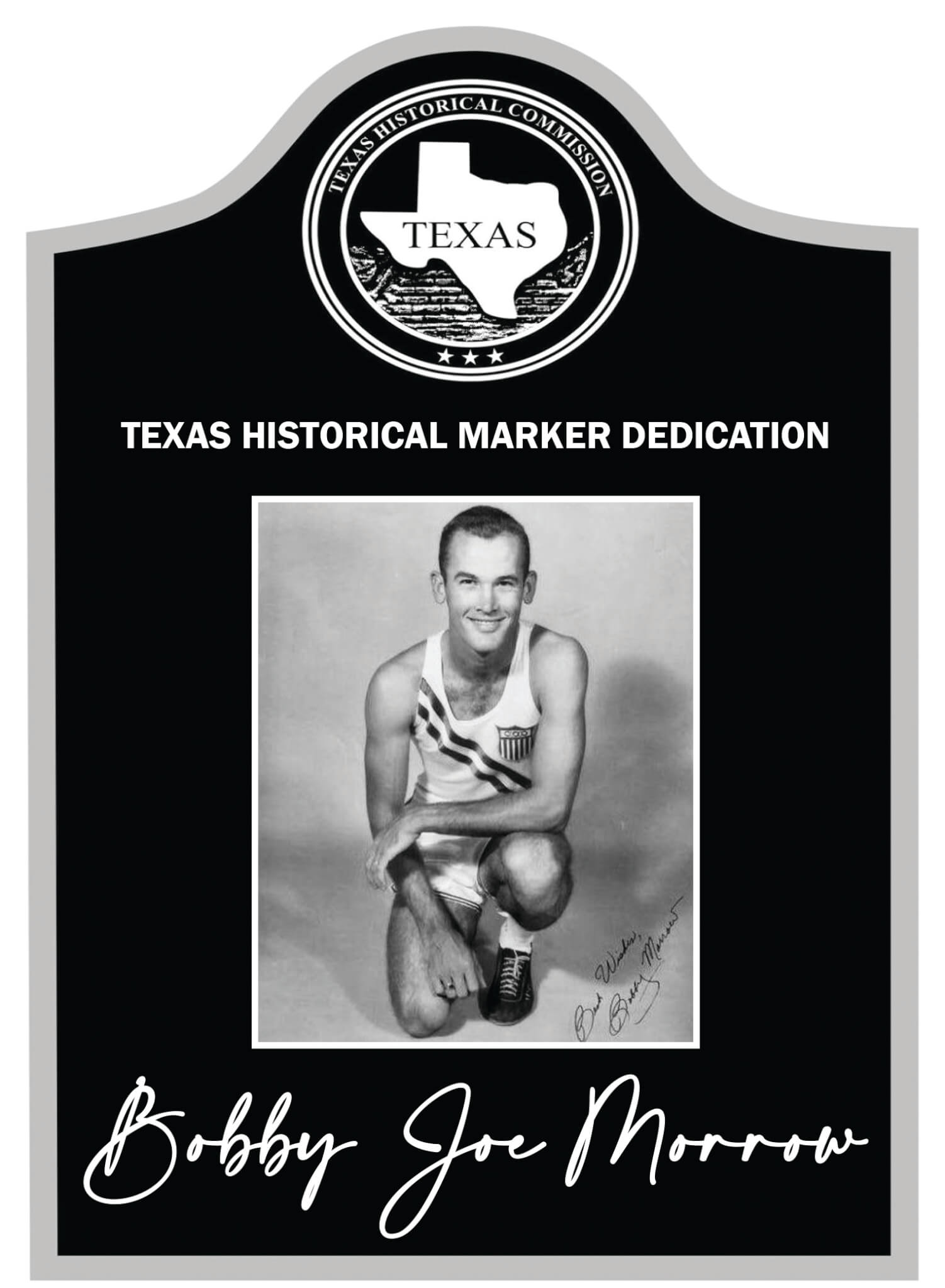
The San Benito Historical Society announced the Texas Historical Commission Marker – Bobby Joe Morrow, will be unveiled and dedicated on Saturday, Aug. 24, 2024 at the front entrance of Bobby Morrow Stadium in San Benito. The public is invited. The ceremony will begin at 10 a.m.
Morrow used to chase jackrabbits barefooted on his father’s cotton farm. During his time at the San Benito High School, he began as a football player, and, “when I got around the end, nobody could catch me.”
By his sophomore year, the school shop built starting blocks for the track team, and his father drove the family tractor to Greyhound Stadium and leveled and smoothed the dirt track before afternoon practice.
Morrow, the middle of three children, was born on Oct. 15, 1935 in Rangerville, TX to Bob Floyd and Mattie Lucille Morrow, who lived in a simple, white clapboard house and owned and operated a cotton farm alongside his four Morrow uncles. After graduating in 1954 from SBHS, Morrow chose Abilene Christian College “because of my Christian upbringing.”
“He was tall and beautifully muscled but slender,” recalls Abilene Christian College Coach Oliver Jackson in a 2000 “Sports Illustrated” article. “He could run a 220 with a root beer float on his head and never spill a drop.”
“Bobby is a born sprinter,” Jackson told reporters. “All you had to do was take one look at him even as a junior in high school, and you couldn’t miss it. He’s big (6 feet 1.5 inches, 175 pounds). He has long legs. He’s got terrific power in his thighs, and he’s got leg speed as well as a big stride.”
“He was poetry,” Jackson said. “He had the size and tremendous power in his legs. He just didn’t have any flaws, not by the time he was a junior, anyway. He could float. About the last quarter of the race, he’d turn it on… and he’s gone.”
Morrow donated his three gold medals to the Smithsonian Institution in Washington, D.C., the Texas Sports Hall of Fame and Abilene Christian University to be examples for others to follow.
Jackson added, “You couldn’t ever tell what Bobby was going to say or do because he was very quiet and didn’t say much. He was not a real enthusiastic type of guy – except when the gun fired. He was pretty enthusiastic when the gun fired.”
“Whatever success I have had is due to being so perfectly relaxed that I can feel my jaw muscles wiggle,” he was quoted as saying in an article by David Wallechinsky in, “The Complete Book of the Olympics” (1984).
Texas Monthly later call him the, “Fastest Nice Christian Boy in the World.”
“He really didn’t see his gifts as anything special. He always said: ‘It’s not like I cured cancer. I just ran.’”
Coach Jackson said Morrow was, “Strong in character. He didn’t ever try to take credit for the winning that we had. He always talked about the other guys on the relay. Bobby was always complimenting them. After the race, they would hug each other. It was a real team effort.”
As Bob Hunter observed, “He was a young American who epitomized what athletes can do and be, and there was enormous social pressure on him to live up both to what he was and to what he might be.”
When, at the close of the hundreds of speeches he made over the next four years at service clubs, athletic banquets, alumni meetings, church camps, and youth rallies, Bobby would say, “I sincerely believe that my greatest race, the Christian race, is the most important of them all and is yet to be won,” no one doubted that he meant every word.





Recent Comments