
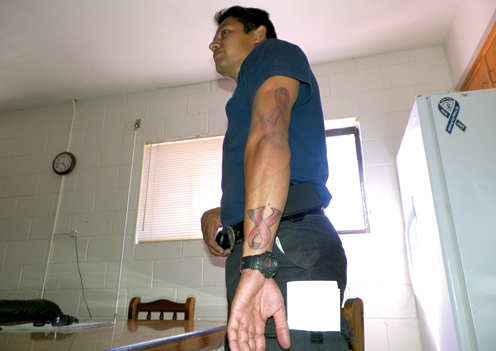
Rene Gonzalez is pictured displaying his tattoos of pink ribbons; his late wife, Lorissa Gonzalez, who passed away this summer after a lengthy bout with a rare form of breast cancer is also shown. (Staff photo by Heather C. Cox)
By HEATHER C. COX
Staff Writer
reporter@sbnewspaper.com

Lorissa Gonzalez
Some people wear their heart on their sleeve, but Rene Gonzalez, 34, of San Benito wears the memory of a woman he loved with his entire being, his wife Lorissa who lost a tough battle with Inflammatory Breast Cancer last July.
A light pink ribbon symbolizes a universal mark for breast cancer awareness. Rene has a large pink ribbon tattooed on the back of his left arm and three small pink ribbons tattooed on the same forearm. He obtained the large ribbon before Lorissa passed away, and the three littler ones serve as a reminder to Rene: to be a good father to his boys. “I’m all they have,” he said in an interview with the News on Wednesday, October 3, in an upstairs room of the San Benito Fire Department.
October has been designated National Breast Cancer Awareness Month (NBCAM). NBCAM is also an organization which defines itself as “a collaboration of national public service organizations, professional medical associations, and government agencies working together to promote breast cancer awareness, share information on the disease, and provide greater access to services.”
According to the American Cancer Society, breast cancer is reportedly the most common cancer among women in the United States, other than skin cancer, and it is the second leading cause of cancer death in women, after lung cancer. About 39,510 deaths from breast cancer have already been reported in 2012. The wife of SBFD’s driver, Rene Gonzalez, is sadly among that number. Married for 14 years, Rene and his high school sweetheart Lorissa, had three boys. According to Rene, “Lorissa was breast-feeding our son, and after about nine months, she noticed some lumps (in her breast). She didn’t think anything of it at first, but she began experiencing pain. The pain was getting worse.”
Some people say they always remember where they were the day they received a diagnosis. “It was January 25,” Rene said with a breathy pause. “I remember, we were driving down the road in Harlingen, and the doctor called and said she had cancer.” He had a sound of sincere pain in his voice when he added, “I was with her, but she could have been driving by herself.”
They both cried.
Since its inception more than 25 years ago, NBCAM has promoted awareness of breast cancer issues and has evolved along with the national dialogue on breast cancer. “NBCAM recognizes that, although many great strides have been made in breast cancer awareness and treatment, there remains much to be accomplished,” according to their website.
Although October is designated as National Breast Cancer Awareness Month, NBCAM encourages women to regularly learn more about breast cancer, breast health and the latest research developments in the field of breast cancer awareness.
According to the American Cancer Society’s most recent estimates for breast cancer in the United States are for 2012, “There are about 226,870 new cases of invasive breast cancer in women, and about 63,300 new cases of carcinoma in situ (CIS) will be found (CIS is non-invasive and is the earliest form of breast cancer).”
The American Cancer Society claims, “The chance of a woman having invasive breast cancer some time during her life is about 1 in 8. The chance of dying from breast cancer is about 1 in 36. Breast cancer death rates have been going down. This is probably the result of finding the cancer earlier and better treatment. Right now there are more than 2.9 million breast cancer survivors in the United States.”
The type of breast cancer Lorissa was diagnosed with is “Inflammatory Breast Cancer. I looked it up,” said Rene. “We didn’t waste any time. Websites say it is an extremely rare form of breast cancer. It can occur in 3-6 percent (of patients). Doctors don’t know how to treat it…”
The American Cancer Society describes inflammatory breast cancer (IBC) as “causing symptoms that are often different from those of more common breast cancers…and it might not show up on a mammogram. Because it doesn’t look like a typical breast cancer, it can be harder to diagnose. IBC tends to occur at a younger age than the more common form of breast cancer…IBC also tends to be more aggressive – it grows and spreads much more quickly – than more common types of breast cancer.”
IBC is also harder to treat successfully than most other types of breast cancer.
“We were going to chemotherapy,” said Rene, “but the treatments stopped working. Doctors scheduled a surgery in Houston last year, but when we went over there, they said they couldn’t do the surgery.” Her case had progressed to a point where doctors told the Gonzalezes she only had two months left to live.
“I was thinking, how are they telling me she has months to live? She looks good. She looks healthy,” Rene said as teardrops rolled down his cheeks. “Then, we came back down here (to the Valley), and we thought doctors would do something here. They said [the same thing]. They said, ‘Maybe you should spend time with family.’”
Rene remembered his wife as an active spirit. He showed this reporter a photograph of the two of them at prom, all smiles, when he recollected, “She was really active. We’d go running, and I’d only run a mile or two. She would run three or four.”
Rene’s smile faded as he explained how breast cancer changed everything. “When she got the cancer, she could hardly walk from the living room to the bedroom. It was hard seeing her slow down because she didn’t like it.”
Lorissa Gonzalez lost her battle with inflammatory breast cancer on July 8, 2012. She was 30 years old. “We’re all trying to be strong,” Rene who was dressed in his firefighter gear said with the voice of a hard-working man. He admitted, “It’s kind of hard. She wanted her life, and some people just throw their lives away.”
Rene is a single dad to his three boys. He explained that, “Sometimes, my youngest, he’s three, he’ll say ‘Mom’s in heaven. She’s an angel.’”
Rene says he also talks to God. He said, “I ask God for comfort. I’m glad [Lorissa] doesn’t have any more pain. I tell my kids…even though something negative happened, there’s something positive. We have to be glad for what we have.”
Rene plans to attend Walk for Women, Saturday, October 6, at South Padre Island. “My boys are going with me. We did it last year, and we’re going to do it again,” he said. “This organization, they do help out. They helped us out with money, and that relieved some stress. It allowed me to not have to worry about some of the bills.”
Rene has additionally received support from the community of San Benito as well as SBFD, where he says next month will mark seven years of service. When he is not working Sundays, Rene likes to take his boys to the Church of Christ in San Benito, and he mentioned sometimes even a trip to Wal-Mart or HEB ends in people asking how he is doing or how they can help.
The Ninth Annual Walk for Women will begin October 5 and is a three-day event dedicated to financially assisting local residents who are fighting breast cancer. Walk for Women, Inc. is requesting donations from local individuals and businesses to assist the fund-raising for this event. For more information on Walk for Women, visit http://spiwalkforwomen.org/.
Read this story in the October 7 edition of the San Benito News, or subscribe to our E-Edition by clicking here.





1 comment
I lost my sister to breast cancer 15 yrs. ago. She was so full of life and she felt it in her heart that she would kick this disease but it was not to be. People who have gone through this kind of pain only know how it feels. It doesn’t matter how much money, clothes, jewelry you have but really matters is your health. Not one day goes by that I don’t miss my sister. I know that she is watching over us because sometimes I feel so close to her that I talk to her and feel comfort knowing that she is near. May God Bless Rene and his family. God has a plan for all of us.