
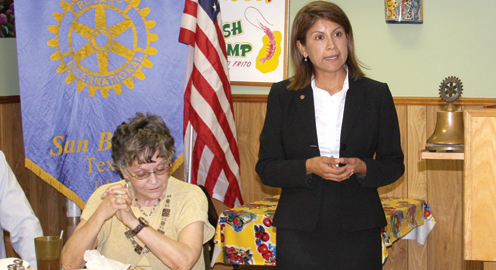
Cameron County Assistant District Attorney Chief Prosecutor Maria De Ford is shown speaking at a Rotary Club meeting Thursday. (Photo by Joe Bocanegra)
By JOE BOCANEGRA
Special to the NEWS
Cameron County Assistant District Attorney Chief Prosecutor Maria De Ford was the guest speaker at the San Benito Rotary Club meeting Thursday at Blanquita’s Mexican Restaurant.
In the meeting she was speaking for Maggie’s and Monica’s Houses, advocacy centers dealing with treating abused children, where she was talking about “One With Courage”, a campaign concerning informing the public on the difficulty of abused children to come out and report that they have been abused.
“Statistically, when a child is abused, they do not come forward because they think they feel responsible, because they blame themselves, because they are threatened.” she told the Rotarians in attendance. “You’d think that when a child is threatened, they will immediately tell someone else, a parent, a teacher, but that is not the case. They will keep it to themselves, some they will never tell, some will take them many years to tell.”
The chief prosecutor also said that there have been many cases in which the parents were told that the child has been abused but refused to report it. In some instances, the person accused of the abuse is the parent or a close relative, even someone close to the family.
“I’ve seen it so many times in my office,” she said. “People are in tears saying, ‘I would have never thought this person would hurt my child… I trusted that person with my life.’ And yet here we are, on trial, going against that person.”
“Another terrible thing I have been seeing here in Cameron County,” she continued, “is a lot of violent crimes against children, usually children under two, by their caregivers – usually be their parents. (Children) are sustaining severe injuries, usually blows to the head, broken bones… and those cases are increasing.”
Referring to such as crimes that occur in private, she noted further that with no witnesses to question it is often the victim’s word against the suspect’s. “And a lot of times that is all we have,” she said. “So we do not have the opportunity to look at the child for any kind of evidence, especially DNA evidence. We try to persuade the jury on what happens when the child gets abused, when the child gets sexually abused. We have specialists come in and inform the jury what happens, but if they believe the child, then it is over, the defendant is guilty.”
To see this story in print, pick up a copy of the Aug. 21 edition of the San Benito News. Or view our E-Edition by clicking here.





Recent Comments