
ESTANI FREZZELL
By ALBERT VILLEGAS
Special to the NEWS
Estani Frizzell, a multitalented artist, and documentarian, has discovered a link to her past in San Benito which has led to a passion project collaboration with one of its museums.
The era was the 1960s and 70s, and the singer was Rosita Lopez from San Antonio her granddaughter is Estani Frizzell.
Lopez, who just turned 90, sang Nortenos and boleros.
Recently, Frizzell established a local connection through the Texas Conjunto Music Hall of Fame & Museum, located at 402 West Robertson St., San Benito.
What started as a casual inquiry on social media turned into a bond between Frizzell and museum co-founders, brother and sister, Patricia and Peter Avila, among others.
Frizzell, as it turns out, is a talented individual who drew inspiration from her grandmother during her youth.
Frizzell herself is a multifaceted singer, songwriter, and music producer who lived in California for 25 years before moving to Austin four years ago. On July 30, during the Hollywood Independent Music Awards at Avalon Hollywood, she and Los Texmaniacs collaborated and won the Best Latin Traditional award for their single, Mi Suerte Ha Cambiado.
Frizzell was recently nominated for a Grammy in the Best Musica Mexicana Album category for the album entitled, Tu De Mi Te Acordaras.
She is also an author of children’s books since becoming a mother 22 years ago. Frizzell now has an interest in gathering details about the museum as relates to this music genre – conjunto.
“She is currently producing a documentary that highlights women in conjunto music and exploring the roots of conjunto music; we are very excited about the exposure that she and her production will bring to the museum,” Patricia Avila said. “Her growing recognition in the industry adds tremendous value to this project and will help amplify the reach and appreciation of conjunto music and the museum on a national level.”
Peter Avila said he connected with Frizzell through social media after she shared a Facebook post about discovering a couple of 45 vinyl records that her grandmother recorded.
“I knew already about her music when I went to the museum, but I didn’t know in what capacity. She was still singing into the early 1980s, and I remember some of it, but I was small at the time,” Frizzell said. “I did find two of her 45s vinyl records during the pandemic. There were four songs she recorded.”
The internet has made it possible for Frizzell to discover her grandmother’s music sung in Spanish. In fact, she found five more tunes on the internet, and when she visited San Benito in October, yet another that Peter Avila showed her existed on another website.
“In her (social media) post, she expressed interest in conjunto music and its cultural roots; I reached out and invited her to visit the museum,” Peter Avila said. “After some correspondence, she agreed to visit and collaborate with us.”
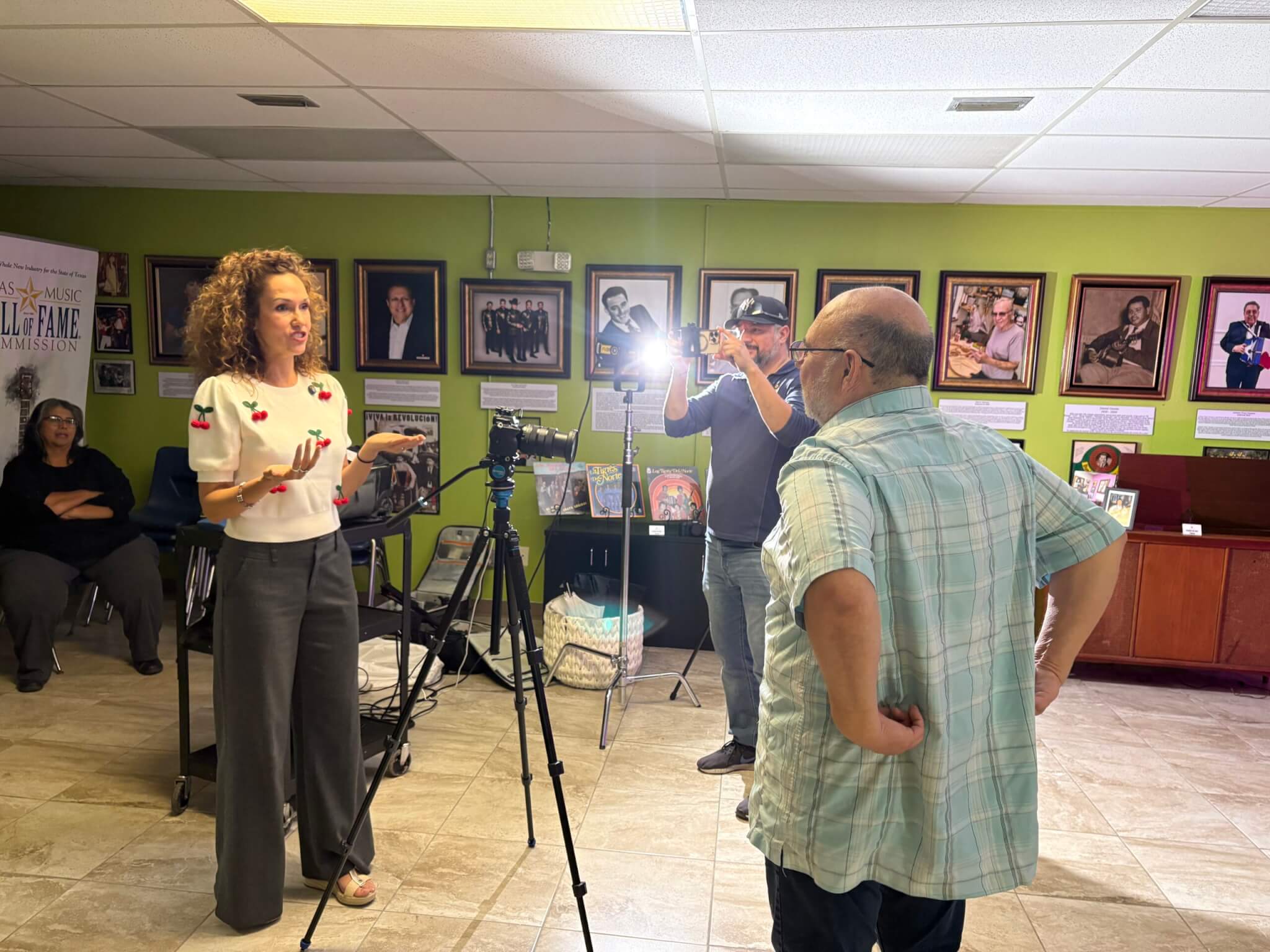
When Frizzell made her initial visit, she interviewed notable guests for the documentary.
Besides the Avilas, others who sat down to answer questions inside the museum were Ricardo Peña Jr., CEO of CHR Records; Hilda Lamas, musical artist for CHR Records, Rick Garcia, UTRGV scholar, and musical artists Veronique Medrano, Fruty Villarreal and Juan A. Tapia.
This esteemed panel shared their stories and perspectives on the roots and evolution of conjunto music.
Patricia Avila recalls the panelists reflecting on the early beginnings of conjunto and how it has transformed over time, with many agreeing that technology has played a major role in promoting the genre and reaching new audiences worldwide.
“Estani’s passion for her work and her commitment to portraying an authentic picture of conjunto music were evident throughout the interviews,” Patricia Avila said. “She has an exceptional ability to make her guests feel comfortable and to speak genuinely from the heart, which allows deep personal and insightful conversations.”
There are plans for a collaboration with local musician Gilberto Perez Jr. to re-record a song originally produced in the 1970s under the Zaz Music-BMI label from San Antonio.
The songs titled “El Burro Pardo” and Contestación Al León de Ayer hold special meaning for Frizzell because they were recorded by her grandmother, who years ago gave her blessings.
Frizzell plans a return to continue the documentary this weekend in San Benito. Among those who are working on the documentary is editor Abis Akolawala.





Recent Comments