
By MARK BETANCOURT
KUT NEWS
This story was produced by The Texas Newsroom and The California Newsroom. The Texas Newsroom is a public radio journalism collaboration that includes NPR, KERA (North Texas), Houston Public Media, KUT (Austin), Texas Public Radio (San Antonio), and other stations across the state. The California Newsroom is a collaboration of public media outlets, including NPR, CalMatters, KQED (San Francisco), LAist, KCRW (Los Angeles), KPBS (San Diego), and other stations across the state. Mose Buchele of The Texas Newsroom contributed reporting.
The Trump administration is sending all pregnant unaccompanied minors apprehended by immigration enforcement to a single group shelter in South Texas located in San Benito.
The decision was made despite urgent objections from the administration’s own health and child welfare officials, who say the facility and the region lack the specialized care the girls require.
That’s according to seven sources who work at the Office of Refugee Resettlement within the U.S. Department of Health and Human Services, which oversees the custody and care of children who cross the border without a parent or legal guardian or are separated from their families by immigration authorities.
Since late July, more than a dozen pregnant minors have been placed at the Texas facility in this small border city. Some were as young as 13, and at least half of those taken in so far became pregnant as a result of rape, according to sources.
Their pregnancies are considered high risk by definition, particularly for the youngest girls.
“This group of kids is clearly recognized as our most vulnerable,” one of the sources said. Rank-and-file staff, the source said, are “losing sleep over it, wondering if kids are going to be placed in programs where they’re not going to have access to the care they need.”
The move marks a sharp departure from longstanding federal practice, which placed pregnant, unaccompanied migrant children in ORR shelters or foster homes nationwide equipped to handle high-risk pregnancies.
ORR sources, along with more than a dozen former government officials, health care professionals, migrant advocates, and civil rights attorneys, said they worry the Trump administration is putting children at risk at the San Benito shelter to advance an ideological goal: denying them access to abortion by placing them in a state where it’s virtually banned.
“This is 100% and exclusively about abortion,” said Jonathan White, a longtime federal health official who ran ORR’s unaccompanied children program for part of President Donald Trump’s first term.
White, who recently retired from the government, said the administration tried and failed to restrict abortion access for unaccompanied minors in 2017. “Now they casually roll out what they brutally fought to accomplish last time and didn’t.”
Asked via email why the administration is sending pregnant children to San Benito, an HHS spokesperson who asked not to be named wrote that “ORR’s placement decisions are guided by child welfare best practices and are designed to ensure each child is housed in the safest, most developmentally appropriate setting, including for children who are pregnant or parenting.”
But several ORR officials took issue with the agency’s statement. “ORR is supposed to be a child welfare organization,” one of them said. “Putting pregnant kids in San Benito is not a decision you make if you care about children’s safety.”
According to an internal email obtained during a six-month investigation by The California Newsroom and The Texas Newsroom, public media collaboratives that worked together to produce this story, ORR’s acting director, Angie Salazar, instructed agency staff to send “any pregnant children” to San Benito starting July 22, 2025.
The move comes despite objections from the government’s health and child welfare officials.
Several sources said a handful of pregnant girls were mistakenly placed in other shelters because immigration authorities didn’t know they were pregnant when they were transferred into ORR custody.
Since the July order, none of the pregnant girls at the San Benito facility have experienced major medical problems, according to ORR sources and Aimee Korolev, deputy director of ProBAR, which provides legal services to children there. They said several of the girls have given birth and are detained with their infants.
But officials interviewed for this story said they worry the shelter is only one high-risk pregnancy away from a catastrophe.
“I feel like we’re just waiting for something terrible to happen,” one of the ORR sources said.
‘Blown away by the level of risk’
According to ORR officials, there are dozens of ORR shelters or foster homes nationwide designated to care for pregnant unaccompanied children, with 12 in Texas alone. None of the officials could recall a time when all the pregnant minors in the agency’s custody were concentrated in a single shelter.
Detaining them in San Benito, doctors and public health experts said, is a dangerous gambit.
“It’s not good to be a pregnant person in Texas, no matter who you are,” said Annie Leone, a nurse midwife who recently spent five years caring for pregnant and postpartum migrant women and girls at a large family shelter not far from San Benito. “So, to put pregnant migrant kids in Texas, and then in one of the worst health care regions of Texas, is not good at all.”
Specialized obstetric care in Texas is mostly available in its larger cities, hours away from San Benito. Several factors, including a high number of uninsured patients, have eroded health care availability across the state.
Furthermore, Texas’ near-ban on abortion has been especially devastating for obstetric care. The law allows an exception when the mother’s life is in danger or one of her bodily functions is at risk, but doctors have been confused about what that means.
Many doctors have left to practice elsewhere, and those who’ve stayed are often afraid to perform procedures they worry could lead to criminal charges. Although Texas passed a law clarifying the exceptions last year, experts have said it may not be enough to assuage doctors’ fears.
Several maternal health experts described a sobering list of risks for the girls at the San Benito shelter: If one of them develops an ectopic pregnancy (where the fertilized egg implants outside the uterus), miscarries, or has her water break too early and then develops an infection, the emergency care she needs could be delayed or denied by doctors wary of the abortion ban.
Getting the care that is available could take too long to save her life or the baby’s, they added.
Adolescents are also more likely to give birth prematurely, which can be life-threatening for both mother and baby. The youngest face complications during labor and delivery because their pelvises aren’t fully developed, said Dr. Anne-Marie Amies Oelschlager, an obstetrician in Washington State who specializes in adolescent pregnancy.
“These are young adolescents who are still going through puberty,” she said. “Their bodies are still changing.”
Pregnant girls who recently endured the often harrowing journey to the U.S. face even greater risk, obstetrics experts said. Many have been raped along the way and have sexually transmitted infections that can be dangerous during pregnancy, add to that limited access to prenatal care or proper nourishment, and then the trauma of detention.
“You couldn’t set up a worse scenario,” said Dr. Blair Cushing, who runs a women’s health clinic in McAllen, about 45 minutes from San Benito. “I’m kind of blown away by the level of risk that they’re concentrating in this facility.”
A history of problems
According to USAspending.gov, the San Benito shelter is owned and operated by Urban Strategies, a for-profit company that has had a federal contract to care for unaccompanied children for more than a decade.
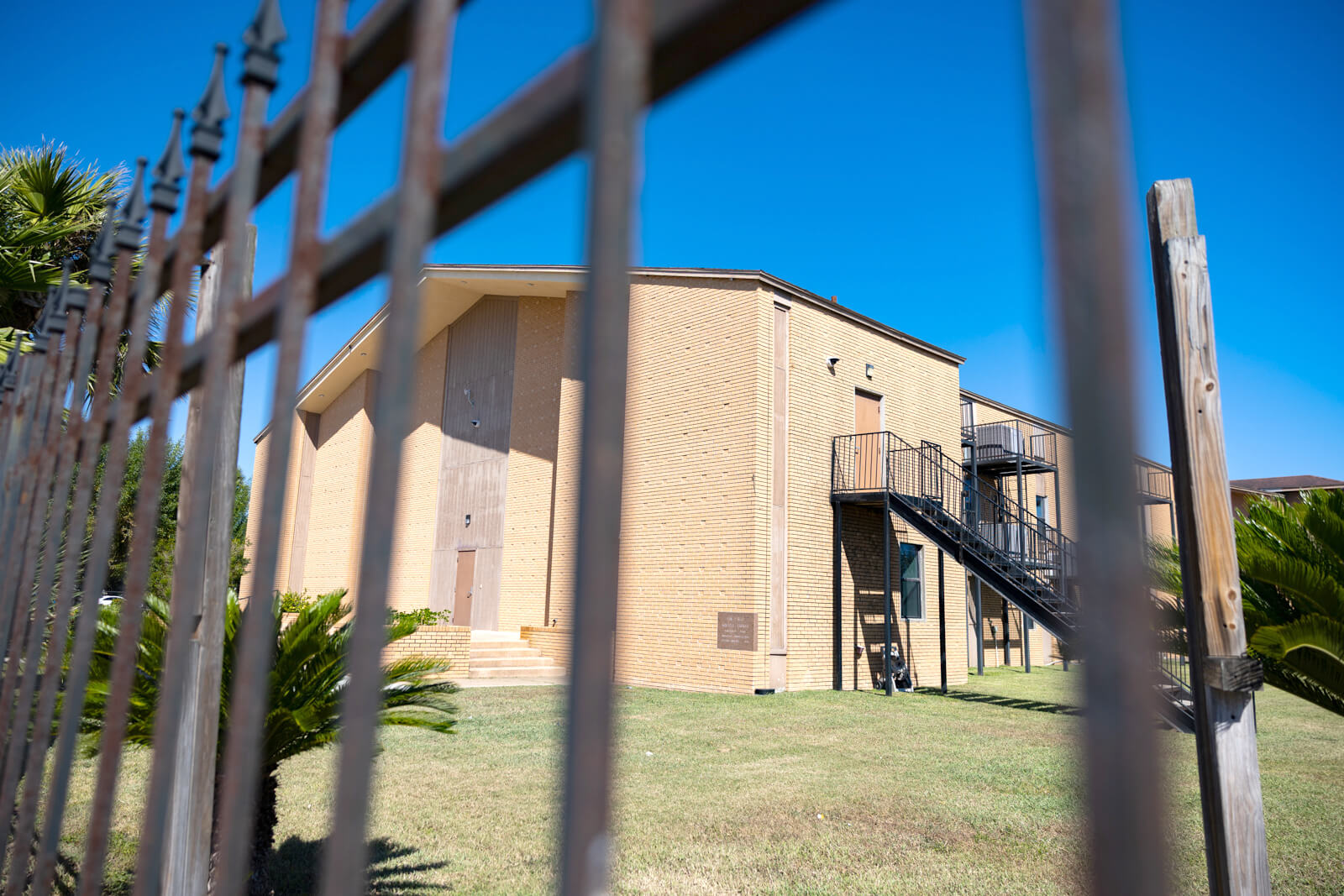
The main building, an old tan-brick former Baptist Church, occupies a city block in downtown San Benito, a quiet town of about 25,000. The church was converted into a migrant shelter in 2015 and was managed by two other contractors before Urban Strategies took it over in 2021.
On a fall day last year, there were no signs of activity at the facility, though children’s lawn toys and playground equipment were visible behind a wooden fence. A guard was stationed at one of the entrances.
“It’s pretty quiet, just like it is today,” said Meliza Fonseca, who lives nearby. “That’s the way it is every day.”
She said she occasionally sees kids playing in the yard on weekends, “but for the most part, you don’t see them there.”
Meliza Fonseca lives across the street from the San Benito shelter. She said she occasionally sees kids in the yard on weekends, “but for the most part, you don’t see them.”
Reached by email, Lisa Cummins, the founder and president of Urban Strategies, wrote that the company is “deeply committed to the care and well-being of the children we serve,” but directed questions about ORR-contracted shelters to the federal agency.
When asked about the San Benito facility, the ORR spokesperson stated, “Urban Strategies has a long-standing record of delivering high-quality care to pregnant unaccompanied minors, with consistently low staff turnover.”
But agency sources who spoke with the newsrooms said that as recently as 2024, staff at the shelter failed to schedule timely medical appointments for pregnant girls, failed to immediately share critical health information with the federal agency, and discharged them without arranging continued medical care.
ORR temporarily barred the shelter from receiving pregnant girls while Urban Strategies implemented a remediation plan, but the plan did not add staff or improve their qualifications, the sources said.
Several sources within the agency said its leadership was provided with a list of shelters better equipped to handle children with high-risk pregnancies. All of those shelters are located outside Texas, in regions where the full range of necessary medical care is available. Yet the directive to place them in San Benito remains.
“It’s cruel, it’s just cruel,” one of the officials said. “They don’t care about any of these kids. They’re playing politics with children’s health.”
‘A dress rehearsal’
Jonathan White, who led ORR’s unaccompanied children program from January 2017 to March 2018, said he wasn’t surprised to learn that the new administration is relocating pregnant unaccompanied children to Texas.
“I’ve been expecting this since Trump returned to office,” White said in an interview.
He said he views the San Benito order as a continuation of an anti-abortion policy shift that began in 2017 and “ultimately proved to be a dress rehearsal for the current administration.”
According to court records, Scott Lloyd, the agency’s director at the time, denied girls in ORR custody permission to terminate their pregnancies. Lloyd also required the girls to receive counseling on the benefits of motherhood and the harms of abortion, and personally pleaded with some of them to reconsider.
“I worked to treat all of the children in ORR care with dignity, including the unborn children,” Lloyd told the newsrooms in an email.
In fall 2017, the American Civil Liberties Union filed a class-action lawsuit against Lloyd and the Trump administration on behalf of pregnant girls in ORR custody. The ACLU argued that denying the girls abortions violated their constitutional rights, as established by the Supreme Court in its 1973 Roe v. Wade decision.
Not long after the lawsuit was filed, White said he received a late-night phone call from Lloyd, who had a request. Lloyd asked White to transfer an unaccompanied pregnant girl seeking an abortion to a migrant shelter in Texas, where, under state law, it would have been too late for her to terminate her pregnancy.
White believed that complying with the order would have been unlawful because it might have denied the girl access to legal relief in the lawsuit, so he refused. The girl was not transferred.
Lloyd, who has since left the government, told the newsrooms that he didn’t believe his request was illegal.
The class-action lawsuit was settled in 2020; the first Trump administration agreed not to interfere with abortion access for migrant youth in federal custody.
Four years later, the Biden administration cemented the deal through official regulations: If a child seeking to terminate her pregnancy was detained in a state where it was illegal, ORR had to move her to a state where it was legal.
That rule remains in place, and the agency appears to be following it. ORR has transferred two pregnant girls out of Texas since July, though agency sources said one of them chose not to terminate her pregnancy. But now that Trump is back in office, his administration is working to eliminate the policy.
‘Elegant and simple’
Even before Trump won reelection, policymakers in his circle were planning a renewed effort to restrict abortion rights for unaccompanied minors.
Project 2025, the Heritage Foundation’s blueprint for a politically conservative overhaul of the federal government, called for ORR to stop facilitating abortions for children in its care. The plan advised the government against detaining unaccompanied children in states where abortion is legal.
Project 2025 argued that such a change is now possible because Roe v. Wade is no longer an obstacle. Since the Supreme Court overturned the landmark decision in 2022, there is no longer a federal right to abortion.
Upon returning to the office, Trump signed an executive order “to end the forced use of federal taxpayer dollars to fund or promote elective abortion.”
Then, in early July, the Department of Justice reconsidered a longstanding federal law governing the use of taxpayer funds for abortion. The DOJ concluded that the government cannot fund the transportation of detainees from one state to another to facilitate abortion access, except in cases of rape or incest or to save the mother’s life.
And now, ORR is working to rescind the Biden-era requirement that pregnant girls seeking an abortion be transferred to states where it’s available. On Jan. 23, the agency submitted the proposed change for government approval, but it has not yet published the details.
Several ORR officials who spoke with the newsrooms said it’s unclear whether children in the agency’s custody who have been raped or need emergency medical care will still be permitted to obtain abortions.
“HHS does not comment on pending or pre-decisional rulemaking,” the agency’s spokesperson wrote when asked for details of the regulatory change. “ORR will continue to comply with all applicable federal laws, including requirements for providing necessary medical care to children in ORR custody.”
But on the day the change was submitted, an unnamed Health and Human Services spokesperson told The Daily Signal, a conservative news site, “Our goal is to save the lives of these young children who are crossing the border, including those who are pregnant, and to save the lives of their unborn babies.”
Like other experts who spoke with the newsrooms, White, the former head of ORR’s unaccompanied children program, said he believes the San Benito directive and the anti-abortion rule change are intended to work together: Once pregnant children are placed at the San Benito shelter, the new regulations could prevent them from being moved out of Texas to obtain abortions — even if doing so would put them at risk.
“It’s so elegant and simple,” White said. “All they have to do is send them to Texas.”





1 comment
A few clues…this facility is a for-profit facility with one goal: maximize profits while providing minimal care to the children. In addition they are a faith based organization that does not necessarily advertise their political leanings. You can be sure their politics aligns with the current administration.
It is not by coincidence that they are allowing young immigrant ladies to have their babies here in Texas since this is an abortion free state.
Taxpayers continue to foot the bill.